
6 mins
Content
UK: Inflation was steady and growth improved, but markets were weaker than elsewhere
Europe: Inflation fell and markets performed well, but growth was weaker
US: Inflation rose, but growth and market returns remained strong
Asia: Markets performed strongly and inflation remained low
Looking ahead
At a glance
June was a positive month for most investment markets, although returns varied around the world. For investors, this is a useful reminder that different parts of a portfolio can perform differently at different times. Inflation, interest rates and global events continued to affect markets, but most major markets still delivered positive returns during the month.
Overview
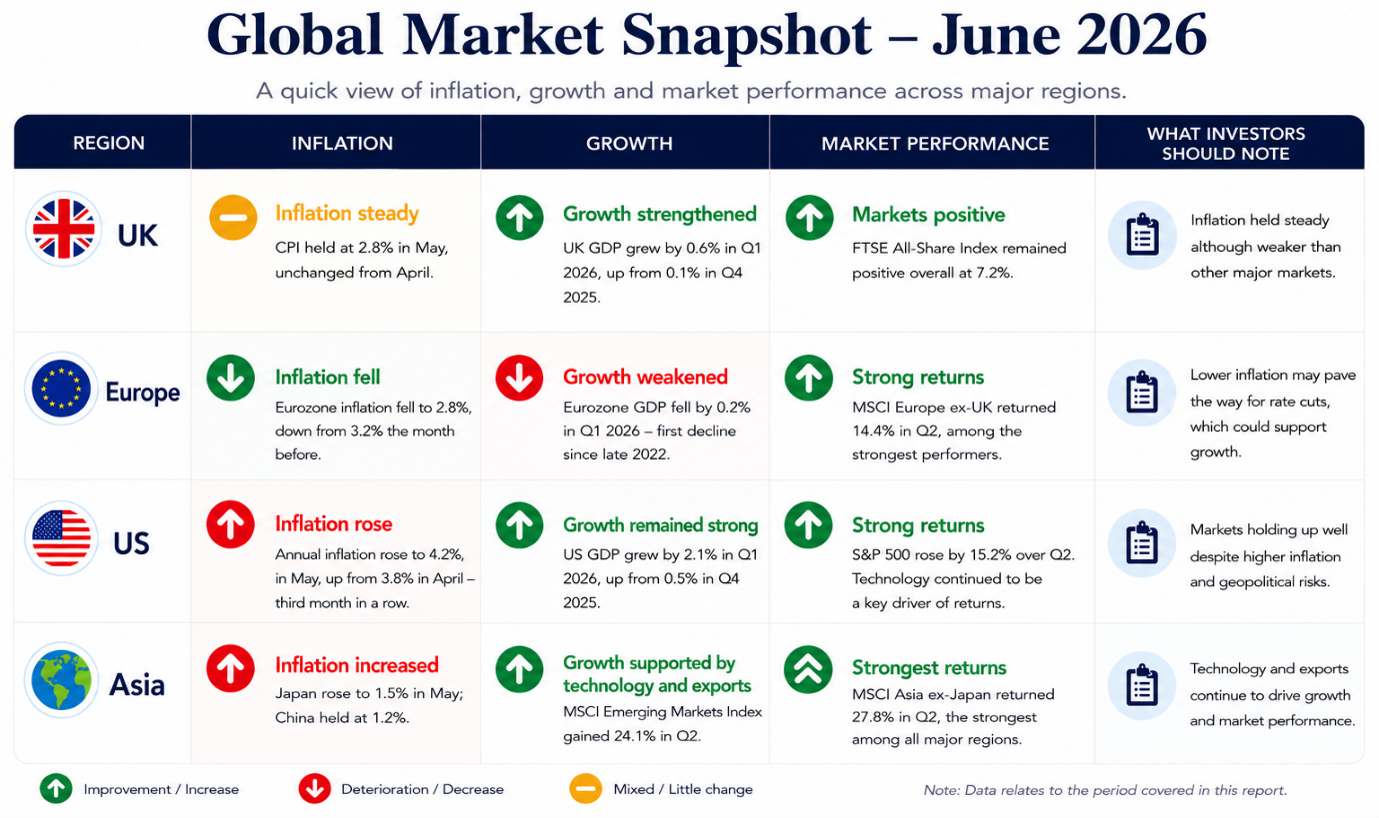
Inflation remained above the 2% target in most regions, although Asia was an exception. Economic growth was generally positive, but Europe saw a small fall in output in the first quarter of 2026. This was largely because Ireland’s headline figures were affected by a sharp fall in exports from large multinational companies, rather than a widespread slowdown across Europe. Ireland’s domestic economy continued to grow¹.
Markets performed differently around the world, but most delivered positive returns. UK markets delivered positive returns, but they did not rise as much as several other major markets. This means UK investors still saw growth, but the UK stock market was not one of the stronger performers over the period. US markets continued to perform well, and Asian markets were among the strongest performers.
Economic and political events can affect markets in the short term. However, the most important factors that shape investment returns usually develop over years, not days.
UK: Inflation was steady and growth improved, but markets were weaker than elsewhere
In the UK, inflation held steady and growth in the first three months of the year was stronger than expected. However, UK markets were weaker than other major markets.
UK inflation was 2.8% in the year to May. This was unchanged from April but still above the Bank of England’s 2% target. Food and drink prices fell, while transport costs pushed inflation up the most².
The Bank of England kept the base rate at 3.75% at its latest meeting, noting that the ongoing conflict in the Middle East could push inflation higher in future³.
The UK economy grew by 0.6% in the first three months of this year, up from 0.1% in the final three months of 2025. This was the strongest growth in more than a year, mainly driven by service-based businesses such as hospitality, finance, retail, healthcare and professional services⁴.
For investors, steady inflation and stronger growth are generally encouraging. Lower inflation can reduce pressure on household finances and may make future interest rate cuts more likely. Stronger growth can also support company profits and business confidence.
However, UK markets remained weaker than other major markets. The FTSE All-Share Index, which tracks around 900 of the UK’s largest listed companies, returned 4.7% over the second quarter. This made it the weakest of the major stock markets in both the second quarter and the year to date, although returns remained positive overall at 7.2%⁵.
Europe: Inflation fell and markets performed well, but growth was weaker
The European economy saw a small fall in output in the first three months of the year, although other signs were more positive.
Figures from June show that Eurozone inflation fell to 2.8%, down from 3.2% the month before. This was the lowest rate for some time. Inflation eased in all major Eurozone economies apart from Spain, where it remained unchanged⁶.
Although inflation improved, the Eurozone economy fell by 0.2% in the first quarter of 2026. This was the first decline since the end of 2022, mainly driven by weaker figures from Ireland rather than a widespread slowdown across the region. Ireland’s economy shrank sharply because of a sudden drop in exports, while France saw a much smaller fall of 0.1%. Other major Eurozone economies continued to grow⁷.
For investors, falling inflation is usually encouraging because it can make interest rate cuts more likely. Lower interest rates can make borrowing cheaper for businesses and consumers, which may help support economic growth.
Despite these wider economic challenges, European markets delivered strong returns in the second quarter. The MSCI Europe ex-UK Index, which tracks larger European companies outside the UK, rose by 14.4%⁸.
US: Inflation rose, but growth and market returns remained strong
Inflation continued to rise in the US, but markets held up well and economic growth remained strong.
US inflation rose to 4.2% in the year to May, up from 3.8% in April. This was the third month in a row that inflation had increased. The rise has mainly been driven by higher energy costs linked to conflict in the Middle East⁹.
Because inflation was rising and remained well above the 2% target, the Federal Reserve kept interest rates unchanged at 3.5% to 3.75% at its June meeting¹⁰.
However, the US economy continued to grow strongly. It grew by 2.1% in the first three months of 2026, up from 0.5% in the final three months of 2025¹¹.
For investors, the US economy is an important part of global market confidence. Higher inflation has made it less clear when interest rates might be cut. However, strong economic growth has helped support confidence in US markets.
US markets reflected this strength. The S&P 500, which tracks 500 large US companies, rose by 15.2% over the second quarter. This was largely driven by enthusiasm surrounding artificial intelligence and solid corporate earnings¹².
Asia: Markets performed strongly and inflation remained low
Asian markets continued to perform strongly, while inflation remained below target levels.
Asian markets were among the strongest performers in the second quarter. The MSCI Asia ex-Japan Index, which tracks larger companies across Asia excluding Japan, returned 27.8%. The MSCI Emerging Markets Index, which tracks companies in developing markets, gained 24.1%. Much of this strength was driven by high demand for electrical equipment and semiconductors used in technology and infrastructure. Japan also had a strong quarter, with the TOPIX Index, which tracks a broad range of companies listed on the Tokyo Stock Exchange, rising by 14.4%¹³.
Inflation across the region remained low and generally stayed below central bank targets. In Japan, annual inflation rose slightly to 1.5% in May, up from 1.4% in April¹⁴. China’s annual inflation held steady at 1.2%¹⁵.
For investors, low inflation can be helpful. It can make it easier for businesses to plan, borrow and grow. Asia also plays an important role in producing technology and electronic components. Together, these factors helped support confidence in the region’s markets.
Looking ahead
Political and global events may continue to cause short-term ups and downs in markets over the months ahead. In the UK, changes in political leadership could also affect market confidence.
Market movements can feel unsettling, especially when headlines are negative. However, short-term ups and downs are a normal part of investing. History shows that markets have tended to recover and grow over the longer term. This is why it can be helpful to stay focused on your financial plan rather than reacting to short-term events.
If you have any questions about your portfolio, or if recent events have made you feel uncertain, please speak to your wealth planner. They will be happy to help.
¹04.06.26 Quarterly National Accounts Quarter 1 2026 Provisional Central Statistics Office Ireland, ²17.06.26 Consumer price inflation, UK: May 2026 ONS, ³18.06.26 Interest rates and Bank Rate: our latest decision Bank of England, ⁴03.07.26 UK GDP Growth Rate Trading Economics, ⁵01.07.26 Review of Markets over May JP Morgan, ⁶02.07.26 Euro Area Inflation Rate Trading Economics, ⁷02.07.26 Euro Area GDP Growth Rate Trading Economics, ⁸01.07.26 Review of Markets over 2025 JP Morgan, ⁹01.07.26 United States Inflation Rate Trading Economics, ¹⁰17.06.26 Warsh to review how Fed works after holding US interest rates at first meeting BBC, ¹¹02.07.26 United States GDP Growth Rate Trading Economics, ¹²06.07.26 US Equities: What’s Hiding Beneath the Market’s Headline Returns? | AB Alliance Bernstein, ¹³01.07.26 Review of Markets over 2025 JP Morgan, ¹⁴02.07.26 Japan Inflation Rate Trading Economics, ¹⁵02.07.26 China Inflation Rate Trading Economics
Please note:
The content of this guide was accurate at the time of writing. Information may change after publication because of changes in circumstances, regulation, or legislation. This guide is for general information only and does not provide personal advice. It is intended for retail clients.
The value of your investment, and any income from it, can go down as well as up. You may not get back the full amount you invested.
Succession Wealth Management Limited is authorised and regulated by the Financial Conduct Authority. Financial Services Register number 588378
Succession Wealth Management Ltd is registered in England at Drake Building, 15 Davy Road, Plymouth Science Park, Derriford, Plymouth, PL6 8BY. Registered Number 078826118