
5 min read
What is Agricultural Property Relief (APR)?
APR is an IHT relief on the “agricultural value” of farmland, farmhouses, and certain other types of agricultural property. Its purpose is to ensure that farms can pass between generations without being forced to sell land to pay IHT.
The relief is either 100% or 50%, depending on the type of property being transferred. While it is typically used by farmers or landowners, APR can also be useful for investors seeking to mitigate IHT on their estate
How Agricultural Property Relief currently works
Your beneficiaries can claim APR on eligible assets provided you owned the property, and it was used and occupied for agricultural purposes for at least:
Two years before your death, if you, a company you controlled, or your spouse or civil partner occupied it
Seven years before your death, if it was occupied by someone else
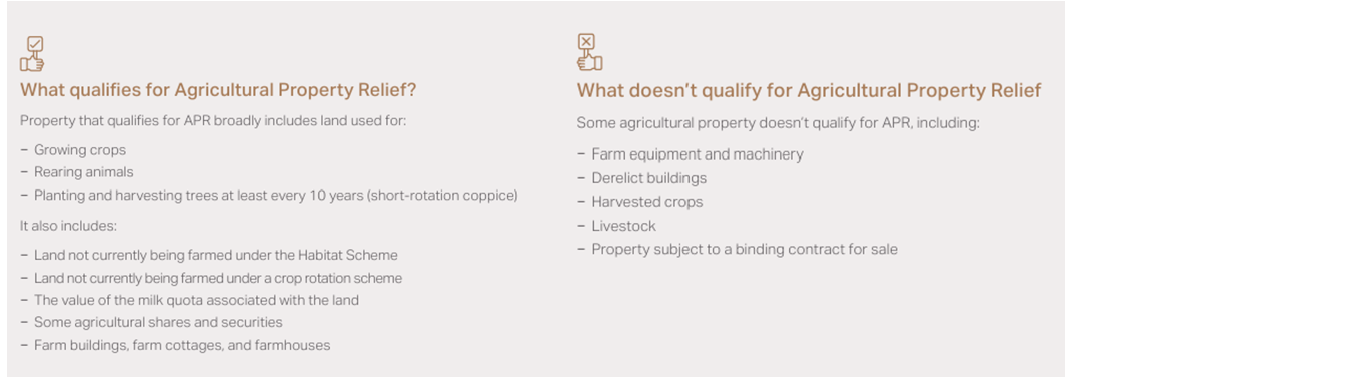
In many common situations, APR is available at 100% of the agricultural value. This typically includes:
Land you owned and farmed yourself
Land used by someone else on a short-term grazing licence
Land you let on a qualifying farm tenancy that began on or after 1 September 1995
Certain older tenancy arrangements and interests that fall within the rules of the Finance Act 1975
If you have assets that are eligible but don’t meet any of the above requirements, the relief may be 50% rather than 100%.
Agricultural Property Relief is set to change from April 2026
The government announced wide-ranging IHT reforms in the 2024 Autumn Budget, along with further updates in 2025, and the changes to APR are set to come into effect from 6 April 2026. Here are the key changes and what they could mean for you
£2.5 million allowance for the full 100% relief - Under the current rules, there is no upper limit on the value of assets that can qualify for BPR. However, from April 2026, you will have a £2.5 million limit on the assets that qualify for 100% BPR
To benefit from APR, certain conditions must be met. Failure to meet them can affect eligibility, which could mean your beneficiaries are left with a higher IHT bill. So watch pout for these common pitfalls:
Misunderstanding what qualifies as agricultural property
Not meeting the minimum time period requirements for ownership and occupation
Valuing the property at market value rather than agricultural value
Not factoring in the new limits to BPR and APR combined
How Agricultural Property Relief fits into wider estate planning
If you qualify for APR, remember that it’s just one part of your estate plan, so it’s a good idea to use it alongside other strategies to help preserve your estate for your beneficiaries. For example, making full use of your nil-rate bands is the simplest way to mitigate IHT on your estate. When combined with other strategies, this can significantly reduce the amount of your estate liable for IHT.

Helping you plan ahead
APR can play a significant role in mitigating IHT, but it’s not always straightforward. A financial planner can help you and your family at every stage of estate planning, including investing in and making claims for APR. They can assess whether APR is appropriate to your wider situation, if your assets will qualify, and how it fits in alongside other allowances and reliefs. By ensuring everyone understands how APR works, you can help protect both the land and the legacy you intend to pass on.
Tools and further support

👉 Click here to read our Business Property Relief Guide
Alternatively, leave your details in the form below and one of our team will be in touch for a no-obligation conversation.
Please note
Please note This guide is for general information only and does not constitute advice. The information is aimed at retail clients only. The Financial Conduct Authority does not regulate advice on taxation, Trusts, Estate Planning, or Will writing.
The content was accurate at the time of writing, changes in circumstances, regulation and legislation after the time of publication may impact on the accuracy of the guide.
This information is based on our current understanding of taxation legislation and regulations. Any levels and bases of, and reliefs from, taxation are subject to change and tax implications will be based on your individual circumstances.
You should seek legal advice to ensure that your Will reflects your wishes and is legally binding.
Important information
Succession Wealth is a trading style of Succession Wealth Management Limited, which is authorised and regulated by the Financial Conduct Authority. Financial Services Register number 588378.
Succession Wealth Management Ltd is registered in England and Wales at The Apex, Brest Road, Derriford Business Park, Derriford, Plymouth PL6 5FL. Registered Number 07882611.
FP2026-096a - last reviewed March 2026